1 August 2015 · Ing. et Ing. arch. Jiří Lukeš
Co-operative and community housing in the 20th century
Co-operative housing is not a socialist invention. In the 20th century, it went through three waves in Europe, from the Viennese settlers through the Siedlung Halen to Danish cohousing and the Zurich co-operatives. What distinguished the West from the East, and what can Czech municipalities build on?
Co-operatives are not a socialist invention
In the Czech Republic, when most people hear the term ‘co-operative flat’, they picture a prefabricated block of flats from the 1970s. However, co-operative and community housing has a much longer history and is far more diverse. In the 20th century, it went through three waves in Europe: self-help and garden cities after 1900, large organisations after 1945, and a return to small groups of residents from the 1970s onwards. All three waves have lessons to offer municipalities that are today seeking ways to provide affordable, high-quality housing.
The first wave: people building their own homes
At the turn of the 19th and 20th centuries, housing co-operatives sprang up in industrial towns in response to the housing crisis. In Germany, they were aided by the Co-operative Act of 1889, which allowed the establishment of limited-liability co-operatives. In the Netherlands, the Housing Act of 1901 gave non-profit housing associations access to public loans. These associations gave rise to today’s housing corporations.
The most striking example of self-help comes from Vienna after the First World War. People in need of housing and food occupied land on the outskirts of the city and built small houses with gardens. By around 1920, some 40,000 settlers were organised within the movement across roughly twenty associations. These unauthorised land occupations gave rise to recognised settlement cooperatives, such as Rosenhügel and Friedensstadt. The settlers carried out part of the construction work themselves, and the hours they worked were counted as their share. The movement was supported by Adolf Loos, Josef Frank and Margarete Schütte-Lihotzky.
Other examples from that period show that the cooperative was not merely a means of financing, but also a way of living together:
- Freidorf near Basel (1919–1921): a settlement by the Swiss Consumer Co-operative Union, designed by Hannes Meyer. 150 terraced houses and a communal co-operative building with a shop, halls and a school.
- Gartenstadt Falkenberg in Berlin (1913–1916): a garden suburb for a housing co-operative designed by Bruno Taut.
- Het Schip in Amsterdam (1917–1921): a workers’ housing block by Michel de Klerk for the Eigen Haard association, with a post office and school in a single block.
- Żoliborz in Warsaw (1920s and 1930s): a housing estate by the Warsaw Housing Cooperative, featuring schools, a library and laundries, on which Barbara and Stanisław Brukalski worked.
Halen: the neighbourhood as architecture
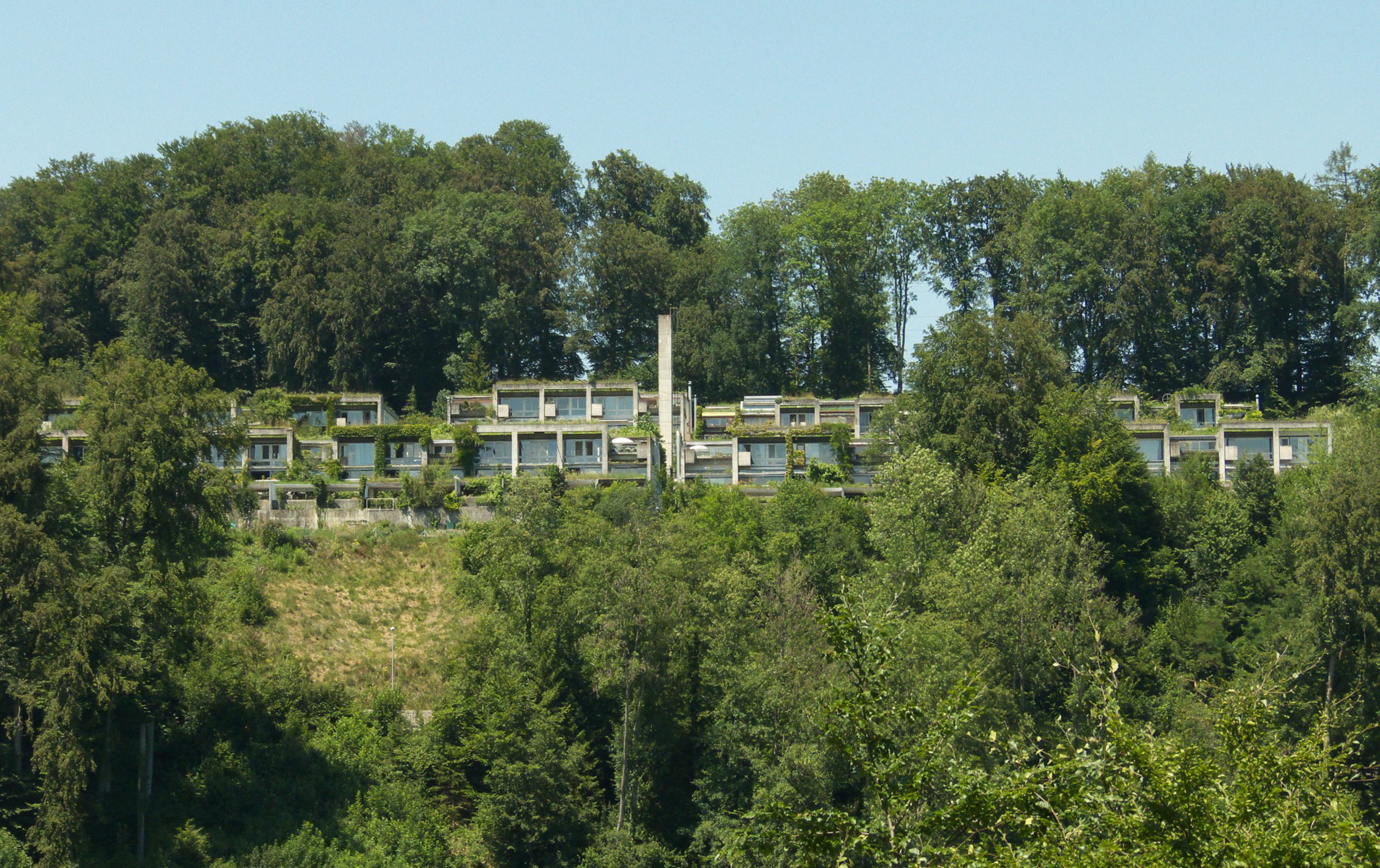
The Siedlung Halen near Bern, built by Atelier 5 between 1959 and 1961, holds a special place in this history. In a forest clearing, 79 terraced houses were built in five rows, arranged around a small square and pedestrianised streets. The settlement includes laundrettes, a shop, sports facilities and a swimming pool.
Halen was not established as a self-build project or a co-operative. The houses are privately owned, but each owner holds a 1/79 share in the streets, the square and the communal facilities. It is precisely this that makes Halen a lasting model. It demonstrates that high-density development with well-designed communal spaces creates a neighbourhood that has been functioning for over fifty years. It is the layout of the houses and the communal spaces that matters, not the form of ownership.
The Second Wave: Large Organisations and Planning
After 1945, cooperative housing became widespread in both the West and the East, but each side took a different path.
In Sweden, the large co-operative organisations HSB and Riksbyggen built a significant proportion of post-war housing. As early as 1935, the Kollektivhuset, designed by Sven Markelius and Alva Myrdal, was built in Stockholm – a building with a central kitchen and a nursery for working parents. In Germany, the trade union-run organisation Neue Heimat became one of the largest non-profit housing developers in Europe. Following a corruption scandal in 1982, it collapsed and confidence in large organisations suffered.
In the Eastern Bloc, the state took over the co-operatives. In Czechoslovakia, Act No. 27/1959 Coll. established housing construction co-operatives. Members paid a contribution based on the size of their flat; the state provided a subsidy, the State Bank granted a loan, and national committees organised self-help schemes. However, cooperative property was socialist property, and the cooperatives were managed by national committees in accordance with economic plans. In the GDR, workers’ housing cooperatives (AWG) had to cover at least 15 per cent of their costs through the members’ own labour and contributions from enterprises. From 1976 onwards, they accounted for around 45 per cent of new housing construction. In Poland, co-operatives became the main builders of flats in towns and cities.
The third wave: the return of small groups
Since the 1970s, the initiative has returned to small groups of residents who choose their own plot of land, architect and rules for communal living.
- Sættedammen in Denmark (1972): the first modern cohousing project, comprising 27 households with a communal house and shared dinners. The Danish model spread to the Netherlands, Sweden and the USA.
- Les Palétuviers in Leonding near Linz (1975): architect Fritz Matzinger, working with the future residents, built atrium houses around a shared glazed courtyard. By 2014, 36 such houses had been built, mostly without the involvement of a property developer.
- Walter Segal in Lewisham (1979–1984): 27 houses on municipality-owned land, built by people on the waiting list for municipality flats. The simple timber frame required no brickwork or concrete. The municipality held a 50 per cent share, whilst the builder held the other half, the value of which was reduced by the value of the labour they provided themselves.
- Sargfabrik in Vienna (1996): a residents’ association with public baths and a cultural programme.
- Freiburg-Vauban and Tübingen (since the 1990s): building collectives on municipal land. In Freiburg, the Mietshäuser Syndikat was also established, which buys up houses from the market and transfers them into collective ownership.
- Zurich: new co-operatives such as Kraftwerk1, Kalkbreite and mehr als wohnen build on a tradition dating back to the 1910s.
The United States: pockets of co-operative housing
Co-operative housing also has a long history in the USA, but it has never become part of mainstream public policy. In 1927, a tailors’ trade union co-operative led by Abraham Kazan built the first flats of the Amalgamated Housing Cooperative in the Bronx. Kazan then worked with the trade unions to build around 40,000 co-operative flats, including Co-op City (1971, 15,382 flats). Flats in these co-operatives cannot be sold on the open market.
Self-help in the US has its roots in the New Deal era. In the Penn-Craft settlement in Pennsylvania, from 1937 onwards, miners, together with the Quaker organisation AFSC, built their own homes, along with a co-operative farm and shop. Danish cohousing was introduced to the US by architects Kathryn McCamant and Charles Durrett. The first project was Muir Commons in California (1991). However, American projects are predominantly funded by the residents themselves and therefore mainly serve the middle class.
East and West: who made the decisions
The difference between Western Europe and the Eastern Bloc lay not in the concept of the co-operative, but in who made the decisions.
- In the West, co-operatives were established by residents, trade unions, associations or municipalities. Members’ meetings decided on the project, the architect and the rules. Communal spaces were an integral part of the concept.
- In the East, co-operatives were established by enterprises and national committees with state approval. The designs were standardised, voluntary labour was often compulsory, and communal living was not encouraged.
After 1989, cooperative flats in the Czech Republic were mostly converted into private ownership, and the cooperatives mainly became property managers. The idea of housing outside the market, which cooperatives in Western Europe still uphold today, was lost in our country.
What can we learn from this?
The history of co-operative and community housing offers several lessons that remain relevant today:
- It won’t work without land and cheap credit. In Vienna after 1918, in Lewisham and in present-day Zurich, the municipality or the state provided the land and long-term financing. The residents contributed their time, labour and organisational skills.
- Self-help replaces capital, not expertise. Doing the work yourself works when the building system is simple and managed by experts.
- Space creates community. Halen, Sættedammen and Les Palétuviers show that a communal square, courtyard or dining hall is more important than the size of the flats.
- Self-governance determines quality. Where a co-operative was run by the state, it lost its purpose. Where members make the decisions, it still works even after a hundred years.
For Czech municipalities, this implies that it is better to build on the first and third waves rather than on socialist housing cooperatives. Small groups, land with building rights, expert support and clear rules on accessibility.
Sources
- Siedlerbewegung – WU Wien
- Siedlung Halen – MySwitzerland
- Siedlung Halen: between standards and individuality – arq
- Freidorf Muttenz – World Garden Cities
- Sættedammen – Wikipedia
- The History of Cohousing – Canadian Cohousing Network
- Fritz Matzinger – sdg21
- Walter Segal’s Self-Build Legacy in Lewisham – Self Build
- Government Bill on Co-operative Housing Construction (1959) – Chamber of Deputies of the Czech Republic
- Legal Encyclopaedia of the GDR 1988 – Workers’ Housing Co-operatives
- Barbara Brukalska and WSM – dzieje.pl
- Abraham Kazan – Gotham Centre
- Norvelt and Penn-Craft – IUP