6 February 2026 · Ing. et Ing. arch. Jiří Lukeš
Public space begins with a brief
The main trend in working with public space is neither participation nor placemaking. It is a shift in focus back to the beginning: cities abroad are investing in understanding the site and in producing a high-quality brief before the design phase begins. An overview of the trends and what they mean for Czech municipalities.
It’s not about the technique, but about the beginning
When people talk about trends in public spaces, most think of participation, temporary parklets or green squares. These are all tools. The real shift, which is being seen repeatedly across countries and practices abroad, lies elsewhere: cities are shifting the focus of their work to the very start of a project. They are investing in understanding the site and in a high-quality pro brief before the design phase begins and competitions are launched.
This ‘phase zero’ has its own names, standards and professions abroad. In the Czech Republic, municipalities often skip this stage. An architect receives a general brief, a project is drawn up, and it is only during consultations that it becomes apparent that it addresses something other than what the site actually needs.
Phase Zero: Understanding First
Phase Zero involves independently analysing the site and people’s needs, and recording the results as a binding brief. Only then does the design follow.
- Germany: needs assessment (Bedarfsplanung) is described by the DIN 18205 standard. It is referred to as ‘Phase Zero’ and is agreed upon and paid for separately, prior to the first phase of the project.
- France: the brief for municipalities is prepared by a separate profession, the ‘programmiste’. They draw up a binding ‘programme’ before the competition is launched and then assist the jury in evaluating the proposals.
- United Kingdom: The standard RIBA procedure begins with Phase 0, the strategic definition of the project’s purpose and the client’s brief.
For a municipality, this is a practical budgetary issue. A brief that has its own funding and timeframe is the cheapest way to avoid an expensive project that addresses the wrong problem.
Participation as a professional discipline
Public engagement is no longer a voluntary add-on to be tacked on at the end. In many countries, it is required by law and led by a specialist.
- The Netherlands: the Spatial Planning and Environment Act (Omgevingswet), which comes into force on 1 January 2024, requires municipalities to have a participation policy. When drawing up a land-use plan, they must explain who was involved, what views were expressed and what was done with the results.
- United Kingdom: Since 2021, the country has been promoting design codes, i.e. local rules governing the appearance of the built environment. The Levelling-up and Regeneration Act 2023 made these an integral part of planning, and public engagement is a prerequisite for their preparation.
- Sweden: as early as 2013, the government instructed the Boverket agency to draw up a methodology for municipalities to engage in dialogue with citizens.
At the same time, the nature of participation is changing. Instead of surveys, deliberative forms are becoming more common, whereby a small group of selected residents gives an informed opinion on a specific issue. The OECD counted nearly 300 such examples in 2020 and refers to a ‘deliberative wave’. Others conduct participation without a questionnaire: they observe how people actually use a space, or work with children directly in schools.
The key point is that the outcome of participation must be accountable: who we involved, what was said, and how this was reflected in the pro brief. For the mayor, such documentation is a source of support in decision-making, not a risk.
Test it on a small scale before building it permanently
Tactical urbanism is an approach popularised by Mike Lydon and Anthony Garcia from the firm Street Plans. It involves short-term, low-cost and scalable interventions that lead to long-term change. A temporary adaptation allows the design to be tested before the municipality invests in a permanent structure.
- Since 2010, San Francisco has been converting parking spaces into small public terraces (parcelles). The Pavement to Parks programme has created over fifty of them.
- New York first temporarily closed parts of Times Square to cars in 2009 and installed chairs there. Following an evaluation, these were turned into permanent pedestrian areas.
- Delft is a historic example: in the 1970s, residents themselves redesigned a street to slow down traffic. This gave rise to the ‘woonerf’, a residential street concept which the Netherlands enshrined in its highway code in 1976.
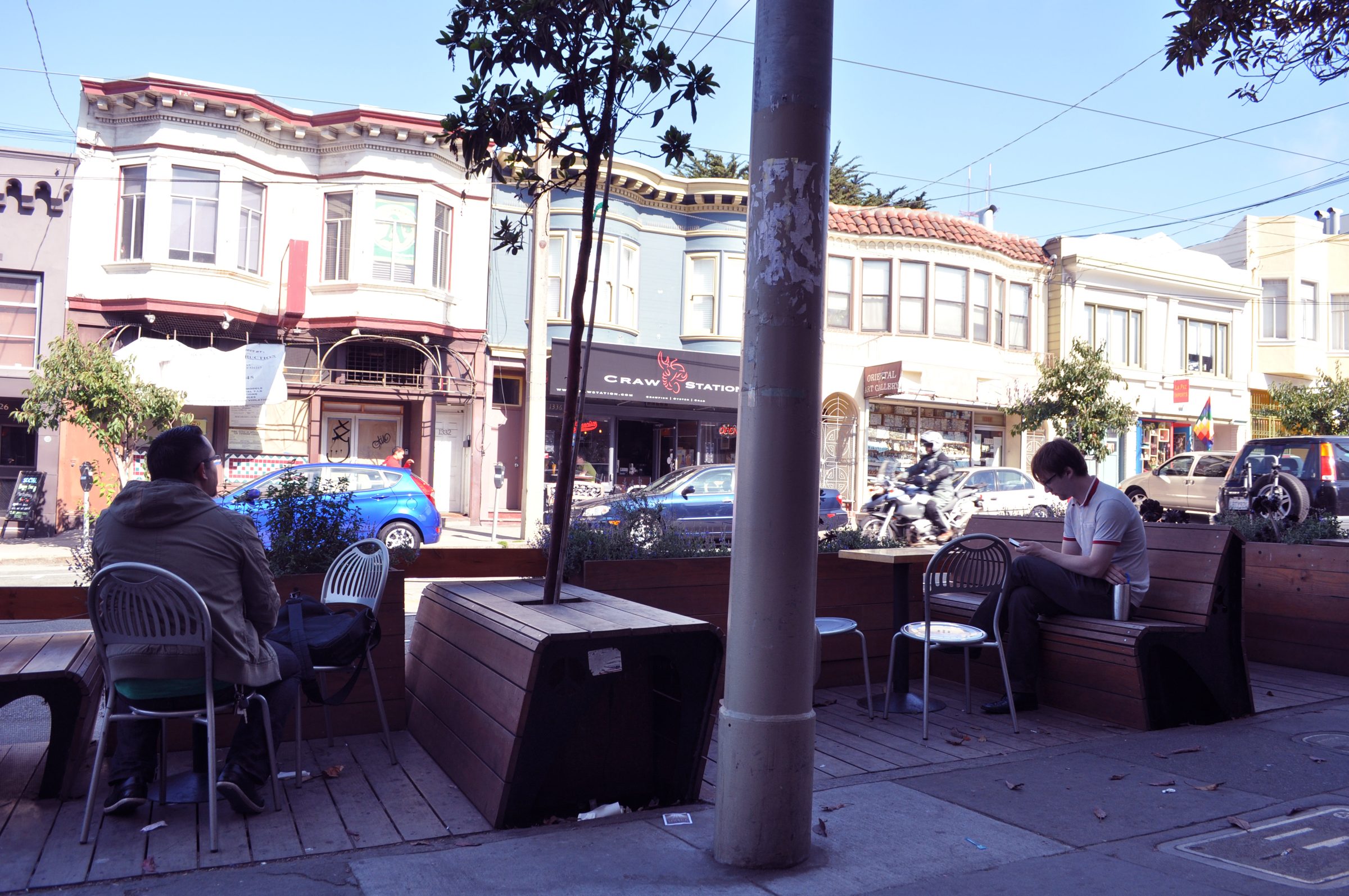
Tactical urbanism is participation in action. People experience the change first, and only then is a decision made about it. For municipalities in the Czech Republic, it is useful as an official preparatory step – that is, a pilot test or brief – rather than as improvisation.
Data rather than impressions
Decisions regarding public space s are increasingly based on observation and data. The Danish firm Gehl has developed methods for monitoring public life: how many people pass through a space, who stops, where people sit, and at what time of day the space is empty. The results often challenge preconceived notions. A busy street may simply be a thoroughfare, whilst a ‘dead’ square may come alive in the evening.
For municipality, this is a cost-effective and straightforward tool. A few days’ worth of observations provide a basis that can be easily justified both to the local council and to residents.
Climate as part of the brief
Hot summers and torrential downpours are transforming public space into infrastructure. Removing tarmac, planting trees, and providing water and shade are no longer merely aesthetic choices, but measures to protect public health.
- Paris, as part of the OASIS programme, is transforming school playgrounds into cooling islands: less tarmac, more greenery and permeable surfaces. Following ten pilot playgrounds, 75 had been created by 2022. Each transformation began with workshops involving children and teachers.
- Barcelona is making the blocks in the Eixample district more pedestrian-friendly through the ‘superilles’ project. Streets within the blocks are being transformed into spaces for pedestrians, greenery and play.
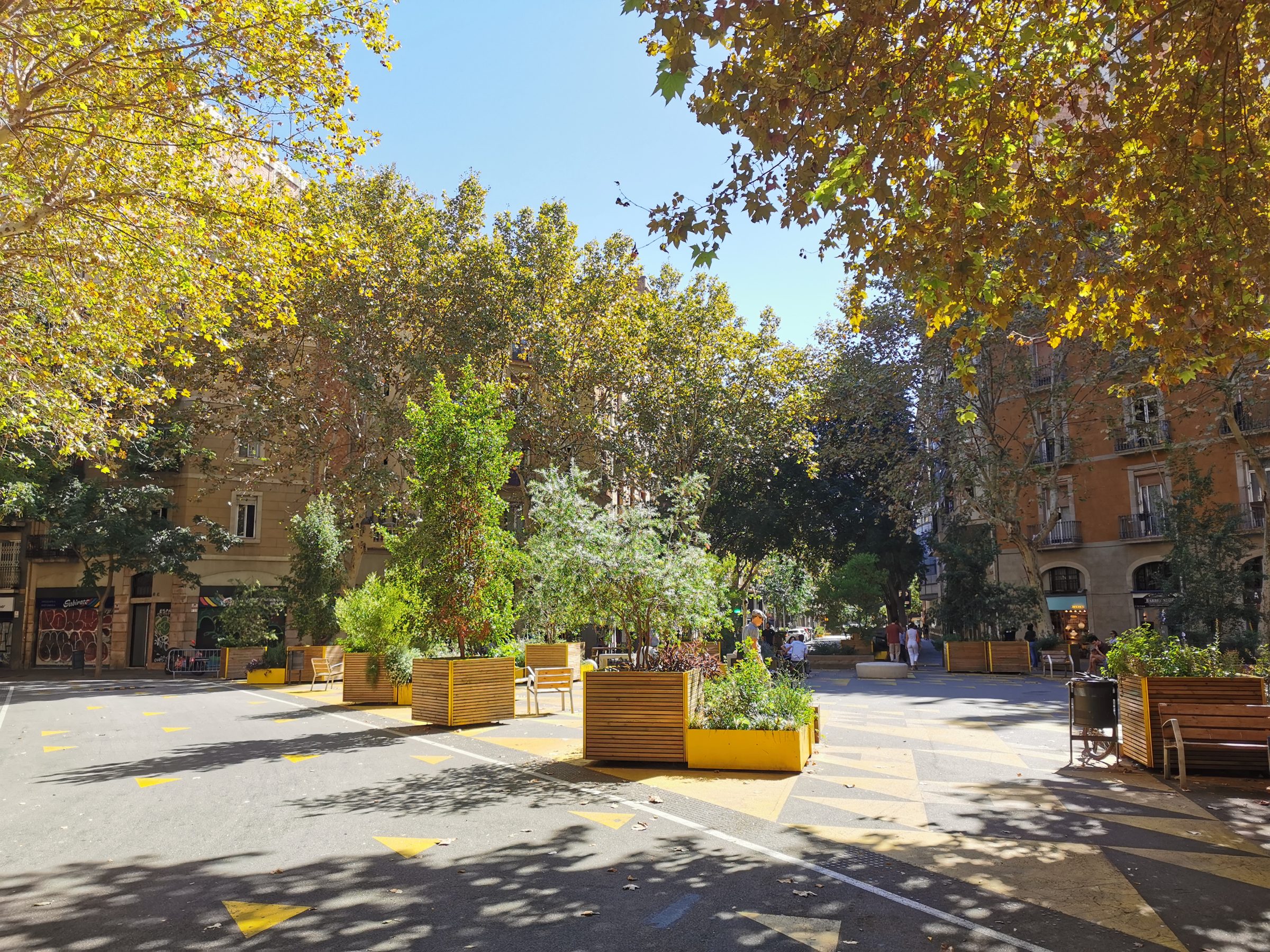
Climate adaptation is also a strong argument in favour of grants. A municipality that has a brief ready will find it easier to secure them.
Build less, make better use
Another trend concerns buildings surrounding public space s. Empty and unused buildings in municipal centres take precedence over new builds on the outskirts. The Austrian firm nonconform organises conferences on empty buildings (Leerstandskonferenz) to address this. A revitalised building on the municipal square does more for public space than new paving.
An expert on the municipality’s side
Municipalities cannot cope on their own. They have few experts and a great deal of responsibility. Models have therefore emerged abroad that strengthen the capacity of the commissioning authority:
- France: municipalities hire a commissioning assistant (AMO) and can turn to a network of advisory centres for architecture and the environment (CAUE).
- Flanders: since 1999, the Flemish State Architect (Vlaams Bouwmeester) has been helping public contracting authorities, including municipalities, to select designers through regular ‘Open Oproep’ calls for proposals. The rules of the call for proposals were last amended in May 2024.
- United Kingdom: Since 2017, the organisation Public Practice has been placing experienced urban planners and architects on one-year placements within local authorities. The reason is simple: fewer than 1 per cent of architects work in the public sector.
Quality over price
Countries with high-quality public space s have one thing in common: they separate the brief from the design and select on the basis of quality, not the lowest price.
- The Netherlands has been using the Best Value Procurement method since 2005. The contractor’s expertise and performance take precedence over price. This is conditional on very clearly defined objectives.
- Germany practises the sale of land owned by the municipality based on the quality of the concept (Konzeptvergabe). In this way, the municipality influences quality even in the case of private investment.
- France generally selects architects through competitions for public buildings exceeding the European threshold (for the years 2026–2027, this is €216,000 excluding VAT). From 22 February 2026, local authorities may dispense with a competition for contracts up to €300,000 excluding VAT (Regulation No. 2026-117). However, even without a competition, the municipality needs a clear brief and selection criteria.
- The United Kingdom has had a new Act on public procurement (Procurement Act 2023) in force since 24 February 2025. Instead of the ‘most economically advantageous tender’, the ‘most advantageous tender’ is now assessed, and contracting authorities must take into account the public benefit of the contract, not just the price.
- Switzerland tackles complex tasks using test planning (Testplanung) in accordance with the SIA 143 standard. Several teams work in parallel on the same task, resulting in recommendations for the next steps.
In the Czech Republic, the Public Procurement Act allows for quality assessment, and the Czech Chamber of Architects recommends that municipalities organise competitions. In practice, however, municipalities often select on the basis of price, and the brief does not include a specific budget.
What this means for municipalities
International experience can be summarised in five steps:
- Allocate a separate budget to the brief. Understanding the site and drawing up a clear brief are separate tasks, not part of the project ‘for free’.
- Involve people in a professional and accountable manner. The outcome of public participation should form the basis for the brief, not merely be a public event.
- Test on a small scale. A temporary modification or pilot scheme prior to a permanent investment will show whether the solution works.
- Select on the basis of quality. A competition or quality assessment only works if it is preceded by a high-quality brief.
- Have an expert on your side. The municipality needs someone to champion its interests from the initial idea right through to the selection of the designer.
A high-quality public space does not begin with the first drawing. It begins with the question of what the space should do for its residents, and with an answer that is clear enough to serve as the basis for the design.
Sources
- ibau – Bedarfsplanung (DIN 18205)
- OECD – Catching the Deliberative Wave (JRC overview)
- ASLA – Everything You Wanted to Know About Tactical Urbanism
- Climate-ADAPT – Paris OASIS schoolyard programme
- Barcelona City Council – Superilles
- Vlaams Bouwmeester – Open Call
- Architecture Today – Public Practice
- Actu-Juridique – Architectural competition: a conditional simplification of procedures
- Landot & associés – competition exemption threshold raised to €300,000 excluding VAT
- Open Access Government – The Procurement Act 2023 and social value